
Key facts in 20 seconds
- A torsion spring is sized by four measurements: wire size, inside diameter, length and wind direction. Change any one and the door is out of balance.
- The spring must match the weight of the door, not its size. Two 16 x 7 doors can weigh 140 lb and 260 lb.
- Standard springs are rated for about 10,000 cycles (one open + close). A family that uses the door 4-6 times a day wears that out in 5-7 years.
- Upgrading to a 25,000-cycle spring costs a little more wire, not a different part – and in Minnesota cold, extra cycle life is the best value on the door.
- Springs are always replaced in pairs on a two-spring door, and always with new cables.
“Do you have my spring on the truck?” is the most common question we get on a broken-spring call across Minneapolis-St. Paul, and the honest answer is: it depends on four numbers, and I measure them before I promise anything. This page explains how garage door torsion springs are actually sized, what the terms on the spring label mean, why cycle life matters more in Minnesota than in a mild climate, and why “close enough” springs are the reason so many doors come back to us. Written by David Tuito, owner-technician at David’s Urgent Garage Door, St. Louis Park.
The four measurements that define a torsion spring
| Measurement | What it is | Why it matters |
|---|---|---|
| Wire size | The thickness of the steel wire the spring is coiled from, e.g. 0.207″, 0.225″, 0.243″, 0.250″, 0.262″ | The biggest factor in lifting force. A wire size one step off changes the balance of the door by roughly 15-20%. |
| Inside diameter (ID) | The diameter of the hole through the spring – residential doors are almost always 1 3/4″ or 2″ | Must match the cones and the shaft; a 2″ spring on 1 3/4″ cones will not seat correctly. |
| Length | The unwound length of the coil, measured without the cones | Longer spring of the same wire = more cycles at the same lift. This is where cycle life is bought. |
| Wind direction | Left-wind or right-wind (the direction the coil spirals). Two-spring doors use one of each; the red-painted cone is usually right-wind | A spring wound the wrong way cannot lift the door at all. On a single-spring door the wind must match the side it is mounted on. |
You can measure wire size on a broken spring by counting coils: 10 coils of 0.250″ wire measure 2 1/2″, 10 coils of 0.207″ wire measure just over 2 1/16″. We use a wire gauge, but the coil-count method is how most technicians double-check.
What “IPPT” means
IPPT stands for inch-pounds per turn: the torque the spring produces for every full turn of wind. A spring’s IPPT is fixed by its wire size, inside diameter and length. The number of turns you wind it (usually 7 to 8 full turns on a 7-foot door) multiplied by the IPPT gives the total torque, and that torque – through the cable drums – has to equal the weight of the door. Two springs on one shaft add their IPPT together, which is why a heavy insulated double door runs two springs instead of one huge one.
In practice we weigh the door (or read the manufacturer’s weight), take the drum size into account, and choose a spring or pair of springs whose torque at the correct number of turns matches that weight. That is what “balanced” means: with the opener disconnected, the door should stay put at knee height, waist height and chest height. A door that drifts down is under-sprung; a door that floats up is over-sprung. Both wear out the opener.
Cycle life: 10,000 vs 25,000 vs 50,000
One cycle is one open plus one close. The industry standard spring is rated for roughly 10,000 cycles. Here is what that means for a Twin Cities household:
| Door use | Cycles per year | 10,000-cycle spring lasts | 25,000-cycle spring lasts |
|---|---|---|---|
| 2 cycles a day (one car, light use) | ~730 | ~13 years | ~34 years |
| 4 cycles a day (typical family) | ~1,460 | ~7 years | ~17 years |
| 8 cycles a day (two cars, kids, garage is the front door) | ~2,900 | ~3.5 years | ~8.5 years |
A higher-cycle spring is not a different technology – it is a longer spring of a slightly heavier wire, which flexes less per cycle and therefore fatigues slower. It costs more steel, not more labor, so the upgrade is usually a small share of the total repair. On doors we service in St. Louis Park, Edina, Minnetonka and Plymouth, where the garage really is the front door, we recommend 25,000-cycle springs almost every time.
Why Minnesota is hard on springs
- Cold makes steel brittle. Spring failures spike on the first sub-zero mornings of the year – the metal is at its stiffest and the door is at its heaviest (frost, snow on the bottom seal).
- Salt and humidity rust the coil. Surface rust creates pits, pits become cracks, and a spring with a crack fails at that spot regardless of its cycle rating. A light coat of spring lubricant once a year is the cheapest life extension there is.
- Insulated doors are heavier. The R-16 to R-18 insulated doors we install for Minnesota winters weigh 30-60% more than the builder-grade door they replace, and they need springs sized for that weight – reusing the old springs is a common mistake.
- The garage is used more. Nobody walks around to the front door at -15 F. More cycles, faster wear.
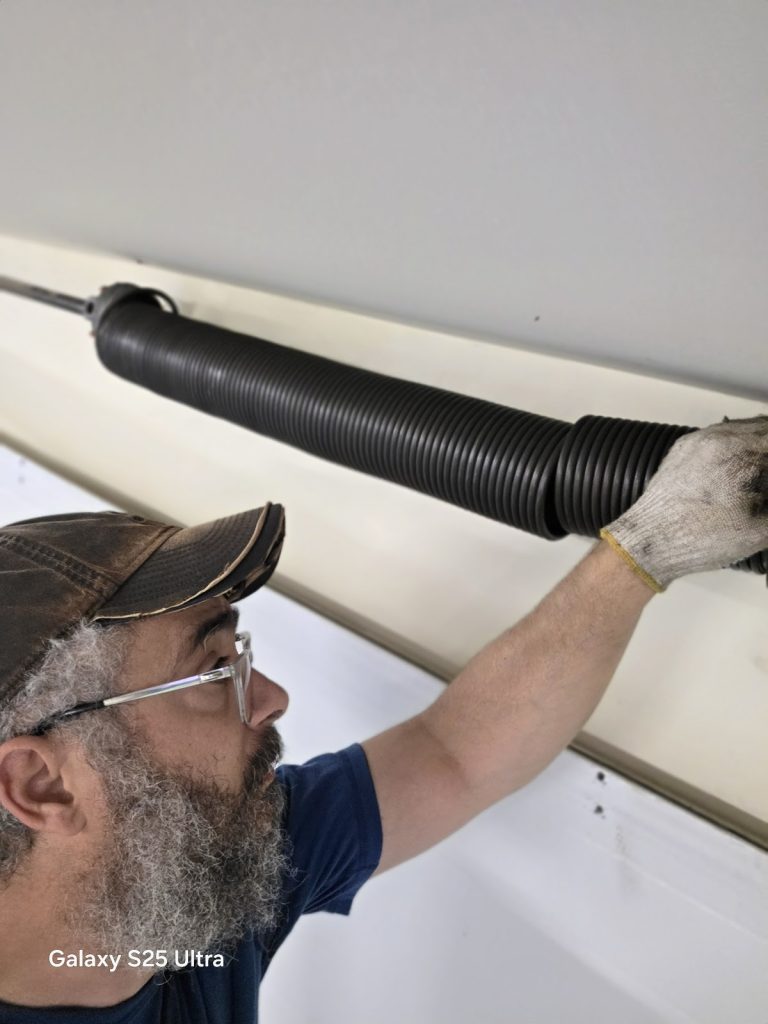


One spring or two? Pairs, conversions and single springs
- Two-spring doors: when one spring breaks, the other has the same number of cycles on it. We replace both, every time. Replacing one leaves you with a call-back in a few months and an unbalanced door in the meantime.
- Single-spring doors: common on single-car doors and on builder-grade installs. When it breaks the door is completely dead. On heavier single-spring doors we often convert to a two-spring setup for safety and cycle life.
- Extension-to-torsion conversion: older doors with springs stretched along the horizontal tracks (extension springs) can be converted to a torsion system. Torsion is safer, quieter and easier to balance – see our spring repair page for what is involved.
- Cables every time: the lift cables live in the same winter slush as the bottom brackets and are the next part to fail; we replace them with every spring job – currently at no charge.
Why this is not a DIY job
A wound torsion spring on a typical double door stores enough energy to lift 200 lb seven feet in the air. It is wound with two steel bars, and if a bar slips out of the cone while under tension it moves faster than you can react. Every year emergency rooms treat hand, face and head injuries from homeowners trying to wind springs with screwdrivers or the wrong bars. Beyond the injury risk, a mis-sized spring quietly destroys the opener over the following months. Measuring, sizing and winding springs is about an hour of work for someone who does it every day – it is the one garage door repair we ask you not to try yourself.
Related: spring replacement service · why cables and bottom brackets rust here · annual tune-up · 24/7 emergency repair
Spring sizing – FAQ
How do I know what size torsion spring my garage door needs?
By the door’s weight and the four spring measurements – wire size, inside diameter, length and wind direction. The size is not printed on the door; a technician weighs the door or reads the manufacturer’s data and matches a spring whose torque at the correct number of turns balances that weight.
What does IPPT mean on a garage door spring?
Inch-pounds per turn – the torque the spring delivers for each full turn it is wound. Multiply IPPT by the number of turns (about 7-8 on a 7-foot door) to get the lifting torque, which must match the door’s weight through the cable drums.
How long does a garage door spring last?
A standard spring is rated for about 10,000 open-close cycles – roughly 7 years for a family using the door 4 times a day, less in Minnesota because cold and salt speed up fatigue. A 25,000-cycle spring lasts about two and a half times longer for a small increase in price.
Should I replace both springs if only one broke?
Yes. Both springs have the same number of cycles on them, and a door with one new and one old spring is out of balance. Replacing both at once is standard practice and saves a second service call.
Can I put a bigger spring on to make the door lighter?
No. An over-sprung door floats up on its own, slams at the top, and strains the opener on the way down. The spring must match the door’s weight; if the door feels heavy, the spring is worn or undersized, not “too small a size”.
Why do garage door springs break in winter?
Cold steel is more brittle, the door is heavier with frost and snow, salt air rusts the coil into pits that become cracks, and the door gets used more. Most of the spring calls we take in Minneapolis-St. Paul come in December through February.