
Short answer: torsion springs sit on a steel bar above the door and twist; extension springs run along the tracks and stretch. Torsion is smoother, safer when it breaks and needed for wall-mount openers; extension is cheaper and fine on lighter doors if safety cables are in place. Either way, springs hold the whole weight of the door and are under high tension, so replacing them is a job for a trained technician.
How to tell which springs you have
- Torsion: one or two large coiled springs on a bar right above the closed door, with a cable drum at each end.
- Extension: long springs above each horizontal track that stretch toward the back wall when the door closes, usually with pulleys and cables.
Side-by-side comparison
| Torsion springs | Extension springs | |
|---|---|---|
| Where | On a shaft above the door | Along each horizontal track |
| How they work | Twist and unwind; cables wind on drums | Stretch and pull through pulleys |
| Door movement | Smoother, better balanced | Can jerk or lift unevenly as parts wear |
| When one breaks | Stays on the shaft | Needs a safety cable through it to stay contained |
| Wall-mount opener | Works | Needs a torsion conversion first |
| Cost | Higher | Lower |
The door industry association DASMA tells homeowners that extension springs must be contained (a safety cable through the spring) and that nobody but a trained technician should touch springs, cables or bottom brackets. More in our garage door safety checklist.
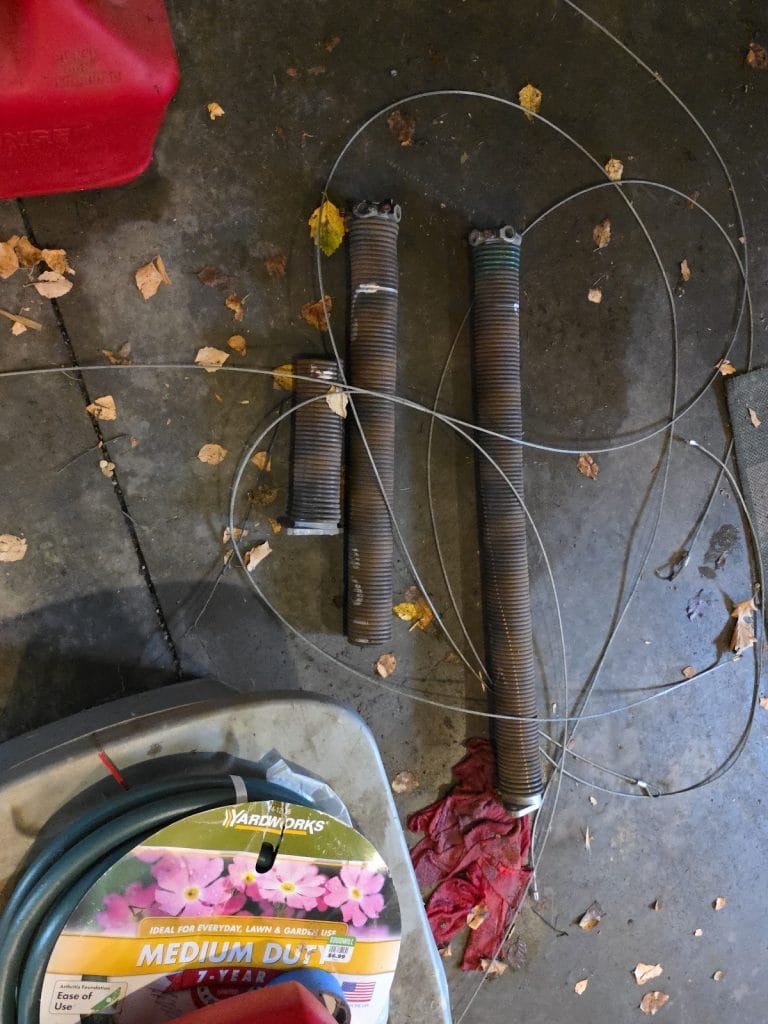
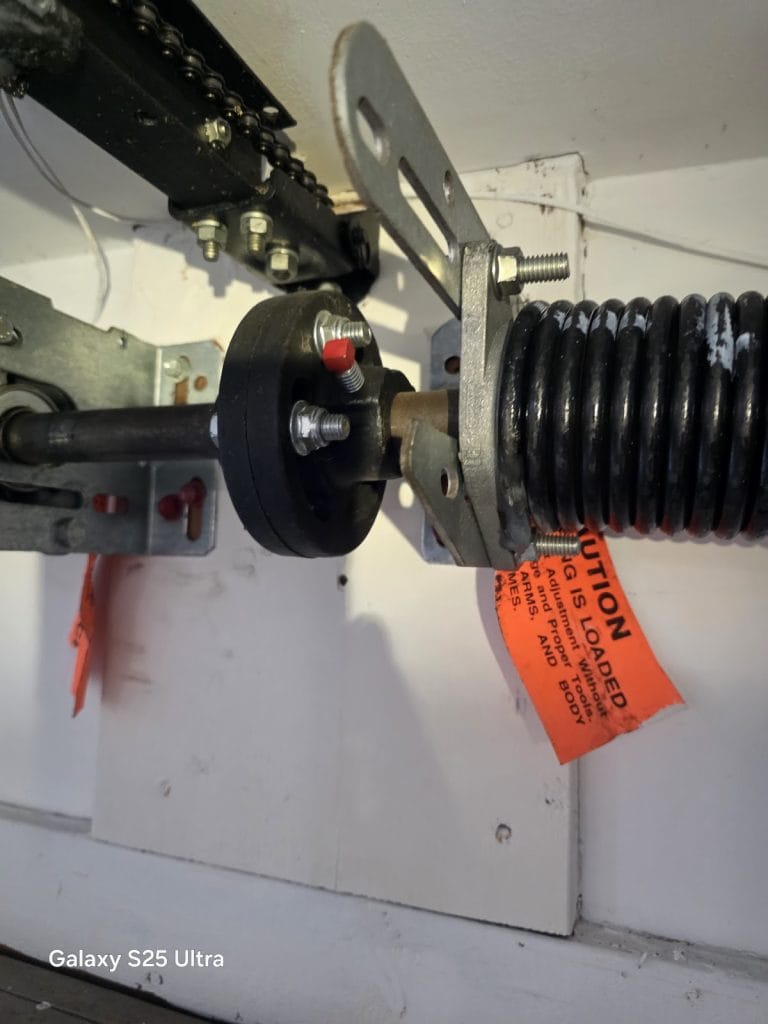
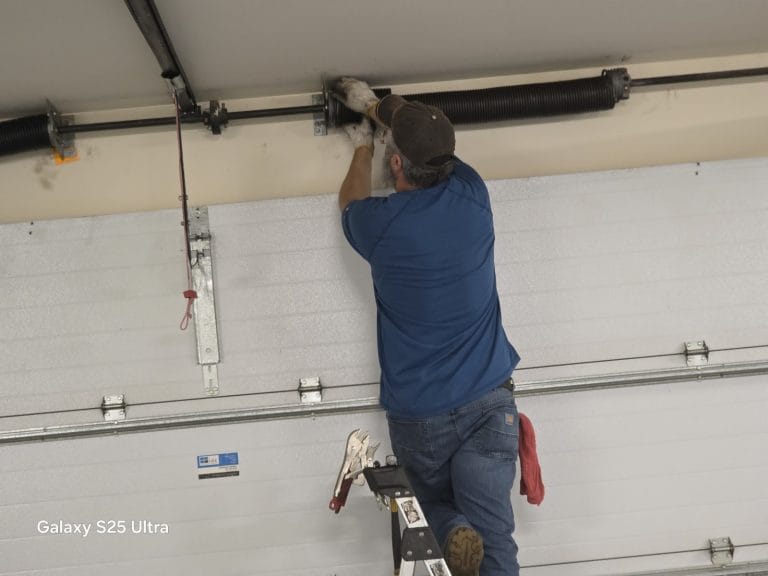
Real spring jobs by David (not stock photos)
How long do springs last?
Standard springs are commonly rated around 10,000 open-and-close cycles. Opening the door several times a day uses that up in a handful of years. Busy households can choose high-cycle torsion springs that last much longer. Read: standard vs. high-cycle springs and how springs are sized (wire size, IPPT, cycle life).
Minnesota tip: check the cables too
Here road salt rusts the bottom of the lift cables and the bottom brackets first. A rusted cable that snaps is a main reason doors come off track in winter, so David checks the cables every time he replaces springs. See why Minnesota cables and brackets rust and snap.
Common questions
How do I know if my garage door has torsion or extension springs?
Look above the closed door. A torsion system has one or two large springs wrapped around a steel bar (shaft) right above the door, with cable drums at each end. Extension springs run along the ceiling next to each horizontal track, stretching toward the back of the garage when the door closes.
Which is better, torsion or extension springs?
For most homes torsion springs are the better system: the door is smoother and better balanced, the spring stays on its shaft if it breaks, and it is required for wall-mount (jackshaft) openers. Extension springs cost less and still work well on lighter doors when they have safety cables through them.
Should both springs be replaced at the same time?
Usually yes. On a two-spring door both springs have done the same number of cycles, so when one breaks the other is close behind. Replacing the pair also keeps the door balanced. David checks the lift cables at the same visit, because Minnesota road salt rusts the bottom of the cables.
How much does garage door spring replacement cost in the Twin Cities?
Spring replacement typically runs about $150 to $350 in Minneapolis-St. Paul, depending on the spring type, size and how many springs the door has. You get the exact price before any work starts. Converting from extension to torsion springs is quoted after seeing the door.
Written by David Tuito, owner and technician of David’s Urgent Garage Door, St. Louis Park, MN (family-owned since 2019, MN State Contractor Registration #IR790255). 1-year labor warranty on repairs.