
Key facts in 20 seconds
- Minneapolis garages are mostly detached, on the alley, behind a 1900s-1940s house on a 40- or 50-foot lot. Three types: the original single-stall (often 1920s-30s, wood door), the tandem (one car wide, two deep), and the rebuilt two-car from the 1990s on.
- The City’s rules for a new or rebuilt detached garage: footprint up to 800 sq ft or 10% of the lot, 13 ft tall without a land use application (16 ft with one), 10-ft max wall, and no setback reduction when the vehicle door faces the alley. Source: City of Minneapolis accessory structures.
- What I fix most in Minneapolis: heavy wood doors on tired extension springs, alley plow and salt damage at the bottom, tandem doors worn out from double duty, and 8-foot doors too narrow for today’s cars.
- Prices from my cost calculator: spring $150 to $350 single, cables $200 to $300, off-track from $450, new insulated door from $2,000, opener $650 to $1,500, winter tune-up $129 with code WINTER. 15 to 30 minutes from St. Louis Park: (763) 265-7671.
Minneapolis is the one city in my service area where the garage is almost never attached to the house. The streetcar neighborhoods (Longfellow, Nokomis, Kingfield, Lyndale, Linden Hills, Fulton, Armatage, Northeast) were platted with alleys, the houses were built from 1900 to 1940 before most families had a car, and the garage went in later at the back of the lot, facing the alley. That one fact decides everything about the door: it faces the plow, the salt and the neighbor’s bumper, it was often built to the size of a 1930 car, and the house in front of it has no room to grow. This guide covers the three garages I see in the city, what breaks on each, and what the City allows when the garage is finally rebuilt. For everything else, my Minneapolis service page; for the same-era suburbs, the Richfield single-stall guide and the St. Louis Park 1950s guide.
Garage 1: the original single-stall
Ten or twelve feet wide, eighteen to twenty deep, a solid-wood door 8 feet wide, hung on extension springs along the track, sometimes still a swing-out or a one-piece tilt-up. These were built from the 1920s to the 1950s and many are still standing on their original hardware. The door is heavy, often over 200 pounds, and the springs were sized for it when it was new and dry. Seventy years later the wood has soaked up water at the bottom, the springs have lost tension, and the opener somebody added in 1995 is doing the lifting the springs should do. Two questions decide the repair: is the frame still square (sight down the jamb), and is the slab still under the bottom rail? If yes to both, a torsion conversion ($150 to $350 for a standard single door, up to $200 more for a double or heavy door; code SPRINGS waives the service call and includes cables), nylon rollers and a new bottom seal buy another ten years. If the bottom sections are soft, a new 8×7 or 9×7 insulated steel door from $2,000 installed weighs half as much and the old hardware stops fighting. Spring replacement, explained.
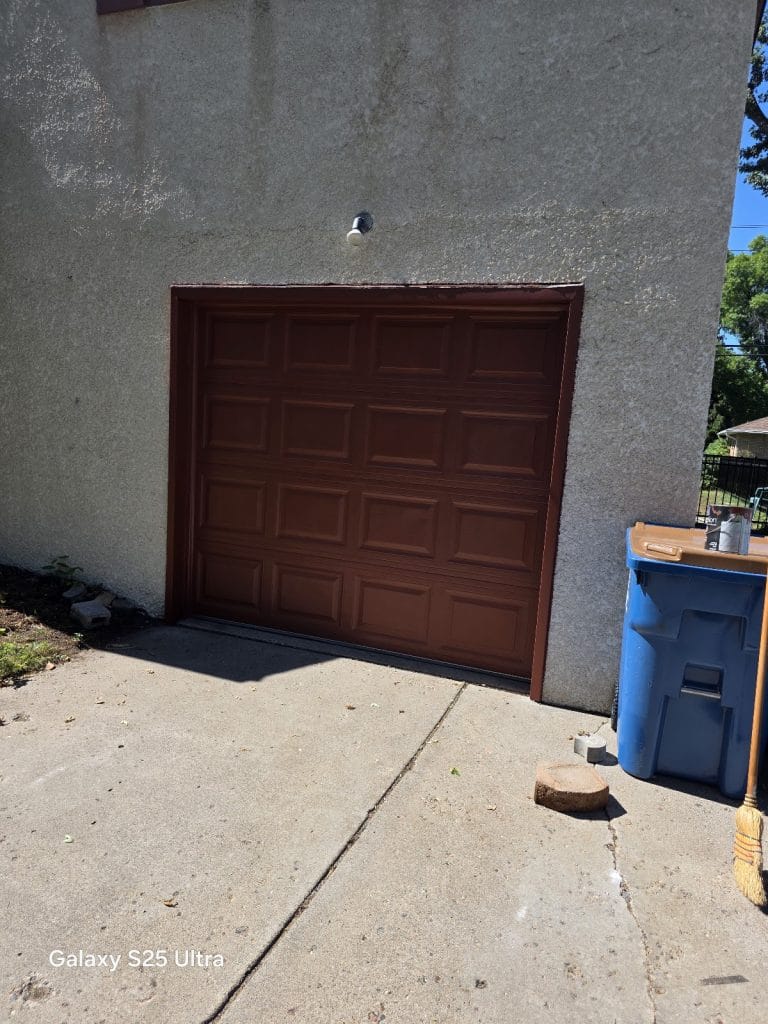

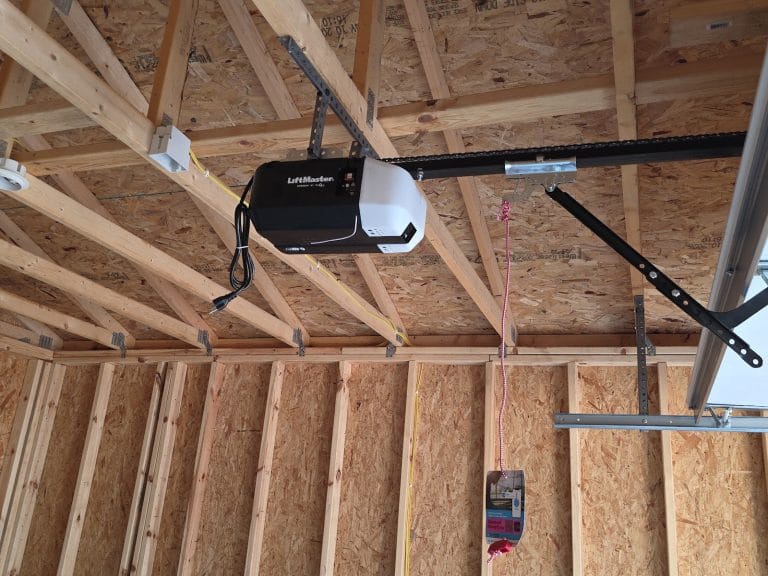
Photos from my own jobs around the Twin Cities.
Garage 2: the tandem
When the lot was too narrow for a two-car garage, Minneapolis builders went deep instead: one car wide, two cars long, one door. You see them beside the house as often as behind it. The door on a tandem does double duty, so its spring reaches its cycle rating in half the years, and the opener rail is often the standard 7-foot length on a garage that needs the door to travel the same distance but sees twice the traffic. When the door fails, both cars are inside. On tandems I size the torsion spring for high cycles, use a belt-drive LiftMaster ($650 to $1,500 installed) with the right rail, and put a strut on the top section so the long, narrow door does not rack. High-cycle springs, explained.
Garage 3: the rebuilt two-car
From the 1990s on, a lot of alley garages were torn down and rebuilt at 20×22 or 22×24 with a 16-foot door, and that is where the City’s accessory-structure rules live: footprint up to 800 square feet or 10 percent of the lot (whichever is greater), 13 feet tall with no land use application or 16 feet with one, a 10-foot maximum wall, 1-foot side and rear setbacks when the garage sits in the rear of the lot, except that a vehicle door facing the rear lot line gets no setback reduction, which on an alley garage means the door wall sits back the standard distance. Exceeding 800 square feet means matching the house’s exterior materials and a $240 administrative review. None of that is my department; what is my department is the door on that rebuilt garage, which is usually a 1990s thin steel door with no strut and a chain opener, now 25 to 30 years old. The common failures are a bowed top section, worn rollers, and a spring at the end of its 10,000 cycles. Section replacement for the bow; how to choose the next door when it is time.
The alley, in winter
Every Minneapolis garage door faces the same three things from December to March: the plow windrow against the door, meltwater that runs from the alley crown toward the slab and freezes the bottom seal down, and salt that eats the bottom section and the bottom brackets. The rules: shovel before you run the opener, never use the opener to break ice, silicone the bottom seal in November, and have the bottom brackets looked at every fall, because a rusted bracket is where the lift cable is anchored. A bent track or a door off its rollers after a plow hit is an off-track repair from $450 including cables; the full winter playbook is in the alley-garage winter guide and why a door won’t open in the cold. The $129 WINTER tune-up (through Dec 15, 2026) covers all of it.
The 8-foot door and the SUV
An 8-foot-wide door with a 6-and-a-half-foot-wide SUV leaves nine inches a side, and the mirrors meet the track about once a winter. A 9-foot door in the same opening is usually possible by moving the jambs and track in a few inches; wider than that is a header and framing question, and on a 1920s garage usually the point where the rebuild conversation starts. How to measure the opening, off-track repair, and before any of it, the Age Check, which tells you what is probably in your garage by the decade the house was built.
Minneapolis garage door questions
Do I need a permit to replace a garage door in Minneapolis?
Swapping a door in the same opening is not a zoning matter; the City’s accessory-structure rules are about the building (footprint, height, setbacks). A new detached garage, or making the opening bigger in a way that changes the structure, is where the City comes in: up to 13 feet tall needs no land use application, up to 16 feet does, the footprint cap is 800 square feet or 10 percent of the lot, and a vehicle door that faces the rear (alley) lot line gets no setback reduction. Check the current handout or call 311 before a rebuild.
What is a tandem garage and why does it matter for the door?
A one-car-wide, two-car-deep garage, common on Minneapolis lots where the garage is beside the house and there is no room to go wider. One 8- or 9-foot door, a long track, and both cars behind the same door. The door works twice as hard, the opener rail is often too short for the depth, and when the door fails both cars are stuck. On a tandem I spec a torsion spring rated for the extra cycles and a belt opener with the right rail length.
My Minneapolis garage door faces the alley and the plow keeps hitting it. What can I do?
Shovel the windrow before the opener, keep the bottom seal clean and siliconed so it cannot freeze down, and have the bottom brackets and lower track checked every fall. A bent track or a door knocked off its rollers is an off-track repair, from $450 including cables; a dented bottom section is $200 to $600 if the panel is still made. On a 1920s or 1950s door, the better money is usually a new insulated steel door from $2,000, which also fixes the rust and the weight.
Why is my old Minneapolis garage door so heavy?
Because it is a solid-wood door from the 1920s to 1950s on extension springs that were sized for a lighter door, or that have simply lost their tension. A 9×7 wood door can weigh over 200 pounds; a modern insulated steel door of the same size weighs about half. If you can barely lift it with the opener released, the springs are wrong, not you. Spring replacement is $150 to $350 for a standard single door, up to $200 more for a double or heavy door.
How fast can you get to Minneapolis?
From St. Louis Park, 15 to 30 minutes to most of south and southwest Minneapolis, same day, including nights and weekends with no weekend surcharge (night surcharge only after 9 PM). Call or text (763) 265-7671.
Door stuck right now? I answer the phone 24 hours a day and am usually on site in about an hour: see 24/7 emergency garage door repair or call (763) 265-7671.