
Your garage door stopped working and you need to get out — or get in. Before you panic, most garage door problems have a clear cause and a clear fix. I’ve been diagnosing garage doors across Minneapolis, St. Paul, and the Twin Cities for years, and I see the same issues over and over. Here’s how to figure out what’s wrong.
Start Here: Is It the Opener or the Door?
The first thing I ask every homeowner: does the opener run but the door doesn’t move, or does nothing happen at all when you press the button?
If the motor runs but the door won’t move — that almost always means a broken spring or snapped cable. The opener is trying, but the door is too heavy to lift without the spring doing its job.
If nothing happens at all — start with the simple stuff first.
The Most Common Reasons Your Garage Door Won’t Open
1. Dead Batteries in the Remote
I know — obvious. But you’d be surprised how often this is the answer. Before you call anyone, swap the batteries in your remote and try again. Also try the wall button inside the garage. If the wall button works but the remote doesn’t, it’s the remote, not the door.
2. Broken Torsion Spring
This is the number one call I get — especially in January and February, when Minnesota temperatures drop below zero and springs become brittle. A broken spring makes a sound like a gunshot when it snaps. After that, the door either won’t open at all, or it opens a few inches and stops.
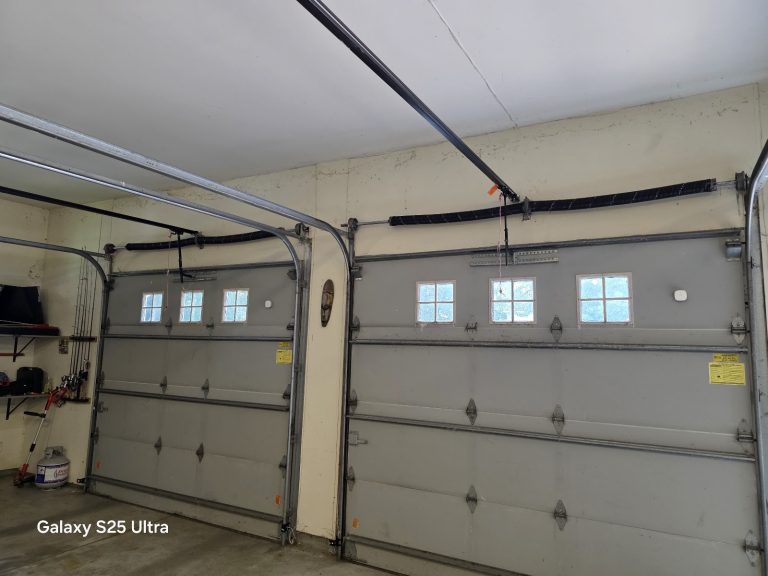
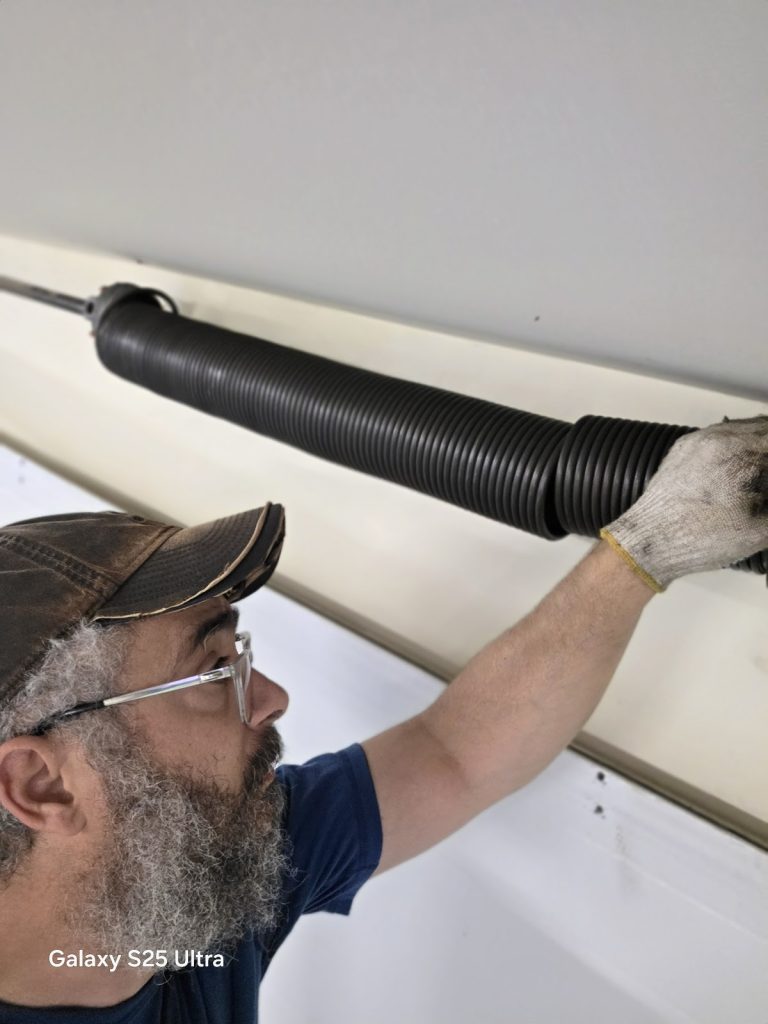
Look above the door — you’ll see the torsion spring mounted horizontally on a metal rod. If it’s broken, there’s a visible gap in the coil, or the spring will look separated in the middle.
Do not try to operate the door with a broken spring. Do not try to fix it yourself. Torsion springs are under enormous tension and cause serious injuries every year. This is a job for a professional.
3. Misaligned or Blocked Safety Sensors
Every garage door opener has two small sensors near the bottom of the tracks — one on each side. They shoot an invisible beam across the opening. If anything blocks that beam, or if the sensors get bumped out of alignment, the door won’t close. It may go up fine but reverse immediately when trying to come down.
Check the sensors: both should have a solid light (usually green on one side, amber on the other). If one is blinking, the beam is blocked or the sensors are misaligned. Clean them with a dry cloth and check if a leaf, cobweb, or piece of debris is blocking the beam. If the lights are still blinking after that, the sensors may need to be realigned.
4. The Door Is Frozen to the Ground
A very common Minnesota-specific problem. After a storm, ice or snow can freeze your door to the ground overnight. When you hit the button in the morning, the opener strains against the frozen door and may burn out the motor if you let it keep trying.
If your door feels unusually heavy or makes a grinding sound and won’t budge, don’t keep pressing the button. Use a heat gun, hair dryer, or pour warm (not boiling) water along the bottom seal to melt the ice. Once it’s free, the door should open normally.
5. Snapped Cable
The cables run alongside the door tracks and connect the door to the spring system. When a cable snaps, one side of the door droops lower than the other, and the door may hang at an angle or come off the track entirely.
A snapped cable is often caused by a broken spring — when a spring lets go, it releases sudden force that can snap a cable too. Like springs, cables should be repaired by a professional. Operating a door with a snapped cable can cause it to fall.
6. The Trolley Is Disconnected
Most garage door openers have a red emergency release cord that disconnects the door from the opener — useful during a power outage so you can open the door manually. If this cord was pulled (accidentally or on purpose), the opener will run but the door won’t move.
To reconnect: pull the release cord toward the door (not away from it) — you’ll hear a click when it re-engages. Then try the opener again.
7. Power Outage
Check if your opener is plugged in and the outlet has power. Power outages are common in Minnesota during ice storms. If the power is out, use the red emergency release cord to open the door manually. This is exactly why I recommend LiftMaster openers with battery backup — the door keeps working even when the power goes out.
8. Worn or Broken Rollers
If the door moves but makes a terrible grinding or scraping noise, and seems to stick or jerk at certain points, the rollers may be worn out or cracked. Cold Minnesota winters make plastic rollers brittle — they crack and bind in the tracks. Replacing rollers is a relatively simple repair that makes a huge difference in how smoothly the door operates.
9. The Door Is Off Its Track
If the door looks crooked, hangs at an angle, or you can see rollers sitting outside the metal track, stop using the opener right away. A door usually jumps its track after a car bumps it or a worn roller finally gives out, and every extra cycle can bend the track and turn a small repair into a big one. This is a job for a technician — our off-track garage door repair team can usually reseat the door the same day.
Quick Diagnostic Checklist
- ✅ Try the wall button — does anything happen?
- ✅ Check remote batteries
- ✅ Is the opener plugged in? Is there power?
- ✅ Is the red release cord disconnected?
- ✅ Check sensor lights — are both solid (not blinking)?
- ✅ Look at the spring above the door — is there a gap or break?
- ✅ Is the door frozen to the ground?
- ✅ Does one side hang lower than the other? (cable issue)
Real jobs by David (owner-operated) — photos from recent Twin Cities calls

When to Call a Professional
Call immediately for: broken spring, snapped cable, door off the tracks, or any situation where the door is stuck open and your home is unsecured. These are not DIY repairs — the risk of injury is real, and a trained technician can fix most of these issues in a single visit.
Two of these causes deserve a closer look: broken springs and doors that have jumped their track. For opener trouble, David repairs and replaces all major brands — see the opener repair and installation page.
Two of the causes above are not DIY: a broken spring (see spring repair) and a door that is physically stuck or off its track. For those, call our emergency garage door repair line — same day, 24/7.
Whatever the cause turns out to be, the matching fix is on our garage door services page, and the FAQ answers the questions we hear most on the phone.
The mirror-image problem – the door starts to close and goes back up – has its own page: garage door will not close: sensors or logic board.
If the opener itself is done, here are the LiftMaster openers David installs, compared side by side.
Two related guides go deeper: the opener hums but the door will not move and the door opens a few inches and stops.
I’m available 24 hours a day, 7 days a week across the Twin Cities metro. If your door is stuck open tonight in a Minnesota winter — that’s an emergency and I treat it that way. Call (763) 265-7671 any time.
Power out? See how to use the emergency release cord safely and reconnect the opener.