
Every garage door spring has a number attached to it that almost nobody talks about at the sales stage: its cycle rating. One cycle is one open-and-close. That number quietly decides whether your next spring lasts seven years or twenty-five — and it explains a lot of the price differences between repair quotes in the Twin Cities.
What a “Cycle” Really Means for Your Door
A standard torsion spring is rated for about 10,000 cycles. That sounds like a lot until you do the math on a real Minnesota household. Two working adults, kids with bikes, the garage acting as the front door — many families open the door 8 to 12 times a day. At ten cycles a day, a 10,000-cycle spring has roughly a thousand days in it: less than three years of heavy use, seven to ten years for lighter use. The spring does not care what year it is; it counts openings.
Standard vs. High-Cycle Springs
A high-cycle spring is not a different technology — it is usually the same spring design made longer or from heavier wire, so each opening flexes the steel a little less. Common upgrades run 25,000 cycles and up. The material cost is moderately higher, but the labor is identical — the tech is already on the ladder with the door apart. That is why the smartest time to choose a high-cycle spring is during a replacement you already need, not as a standalone project.
Why This Matters More in Minnesota
Cold is hard on spring steel. On a below-zero morning the metal is at its most brittle, and the first opening of the day is the hardest flex it will face — which is why so many springs in Minneapolis and St. Paul let go in December and January. A spring that spends its life closer to the middle of its cycle rating, instead of near the end, is simply less likely to pick the coldest week of the year to fail.
Who Should Consider the Upgrade
The honest answer: not everyone. If your garage opens twice a day, a quality standard spring will serve you for many years. But high-cycle springs earn their cost for busy family households where the garage is the main entrance, for doors on the heavier side — insulated double doors and oversized panels — and for anyone converting an old extension-spring setup to a torsion system, since you are choosing new springs anyway. Home businesses and hobby shops that cycle the door constantly are the clearest case of all.
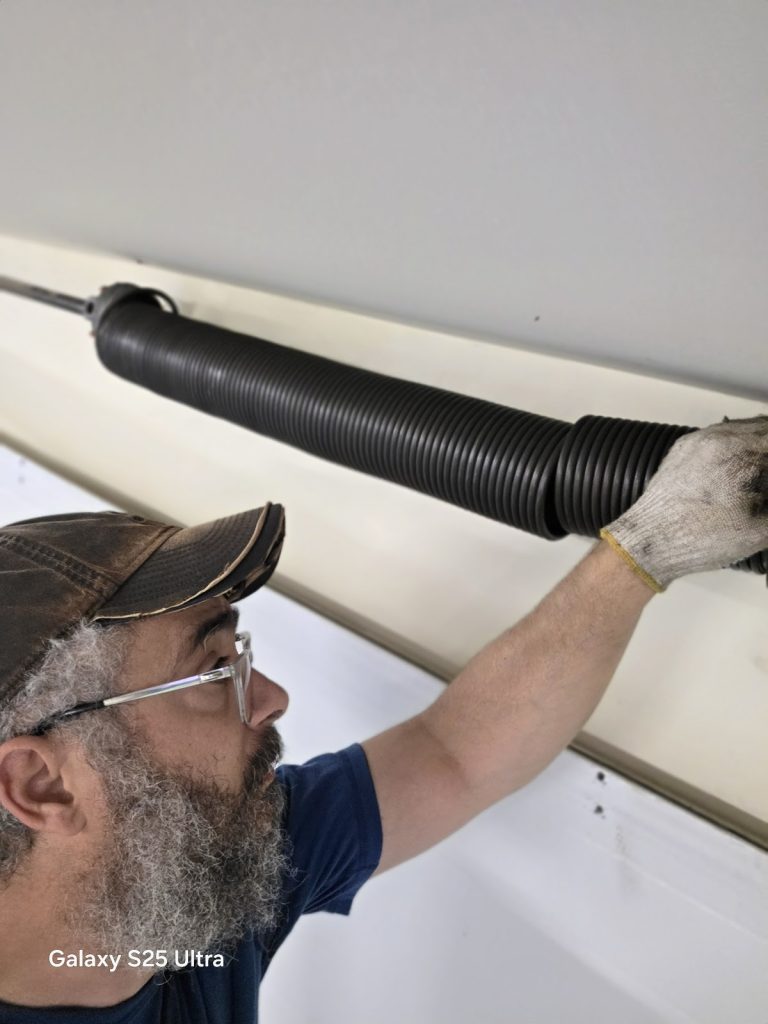
Real jobs by David (owner-operated) — photos from recent Twin Cities calls


What It Costs
Standard spring replacement in the Twin Cities typically runs $150 to $350 (single door; double or heavy doors up to $200 more), as covered in our pricing guide. A high-cycle upgrade adds a modest parts premium on top — ask for the exact number for your door size when you call, because spring price follows wire size and length, not a flat menu. One good rule from the field: if one spring on a two-spring door has failed, replace both. The survivor has the same mileage, and paying for a second service call six months later is the most expensive spring money can buy.
A spring that has tired out shows up as a door that closes faster and lands harder every year – the balance test in that post tells you whether yours is there.
Not sure what is on your door now? Call David: (763) 265-7671 — describe the door and he will tell you what it likely has, what it should have, and what it will cost. Same-day spring replacement across Minneapolis-St. Paul, 24/7.