
Key facts in 20 seconds
- St. Louis Park built itself in one decade: a record 1,122 building permits in 1950 (third in the state behind Minneapolis and St. Paul), 66 subdivisions and 2,700 homes from 1950 to 1956, and about 60 percent of the city’s houses between 1946 and 1954, many on 30- and 40-foot lots. Source: St. Louis Park Historical Society.
- That means a small house with a single-stall garage added later, often 10 to 12 feet wide with an 8-foot door, on a lot with no room to grow: the garage door problems here are about size, alleys and shared driveways, not just age.
- What I fix most in SLP, in order: extension springs on 1950s hardware, the bottom section on alley and shared-drive doors, an 8-foot door that is too narrow for today’s SUV, and a soft wood jamb that will not hold the track bolts.
- Prices from my cost calculator: spring $150 to $350 single, cables $200 to $300, off-track from $450, new insulated door from $2,000, opener $650 to $1,500, tune-up $129 with code WINTER. I live here; (763) 265-7671, usually within the hour.
I run this company from St. Louis Park, and the garage doors here are the ones I know best, because they are the ones I drive past every day. The city’s story is a single decade: when the war ended it was still a village, and by 1955 it had an estimated 9,000 houses. Builders like Bob Fine (about 2,000 homes around Texas Avenue and Minnetonka Boulevard), Ecklund & Swedlund (the Kilmer neighborhood west of County Road 18, the blocks south of Cedar Lake Road), Bruce Construction (Westdale, Crestview, Cedarcrest) and Sam Segal (La Petite Ferme, 1955) put up hundreds of small ramblers at a time, many to VA specifications and an average price of about $7,000, on lots the Village allowed at 30 and 40 feet wide. By 1955 the local paper was reporting that sites were “filling up” and builders were moving on to Bloomington and Edina. This guide is about what that decade left in your garage. For everything else in the city, my St. Louis Park service page; for the nearby cities built in the same years, the Richfield single-stall guide and the Edina split-level guide.
The garage came after the house
A 1950 VA rambler did not need a garage; it needed to cost $25 a month. So the garage on most St. Louis Park lots was added in the late 1950s or 1960s, by the owner or a small contractor, at the back of a 40-foot lot: a single-stall, 10 or 12 feet wide, 20 feet deep, with an 8-foot door, facing the alley in the older neighborhoods (Elmwood, Lenox, Bronx Park, Brookside) or a narrow driveway shared with the neighbor in the 1950s subdivisions west of Highway 100. Two-car garages came with the later houses toward Westwood Hills and Kilmer. The door on that first garage was wood, on extension springs, with a chain opener added in the 1980s if at all.
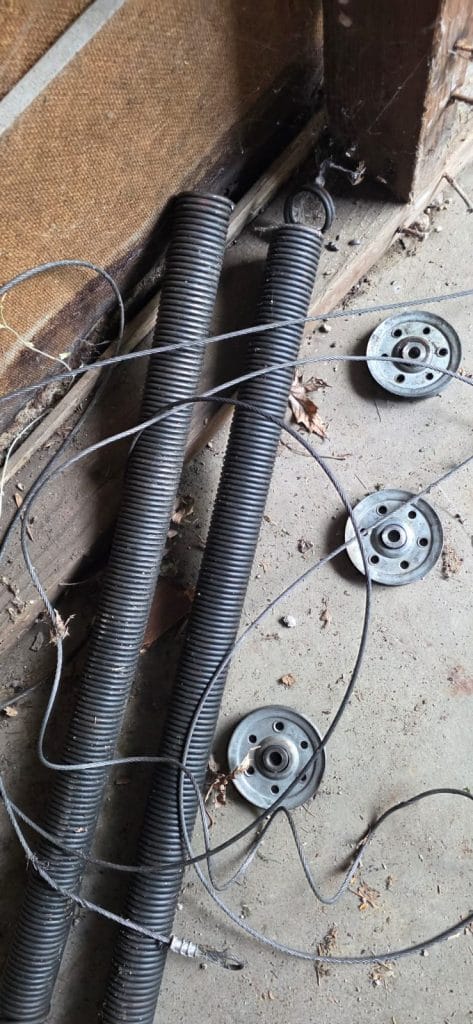
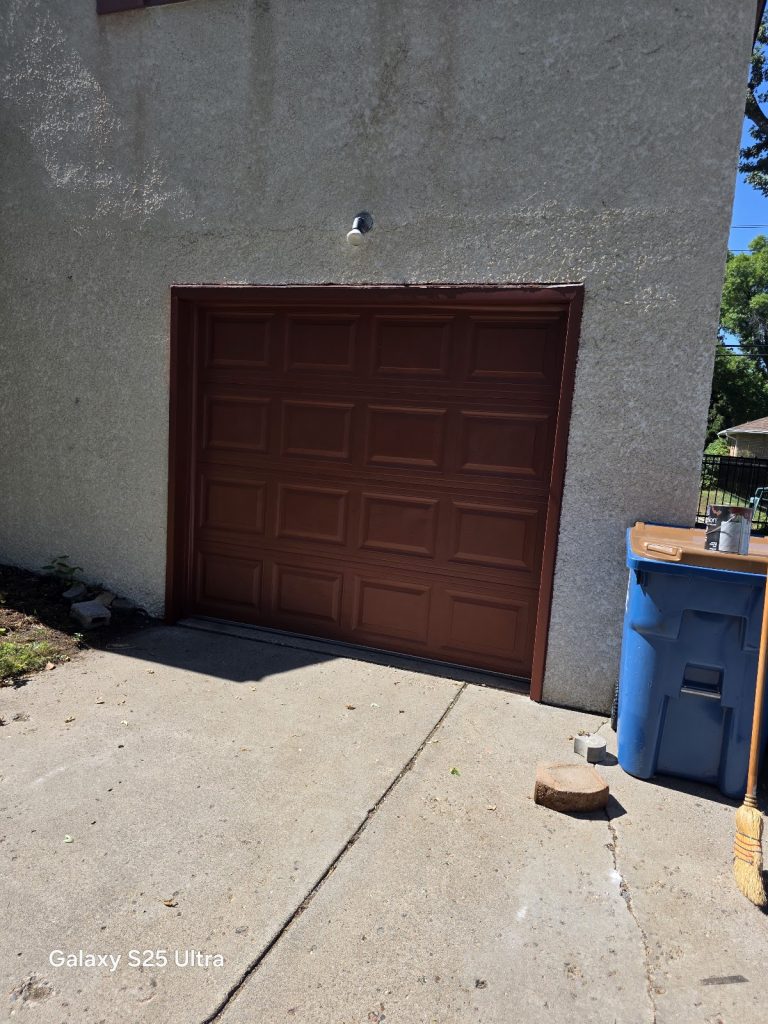
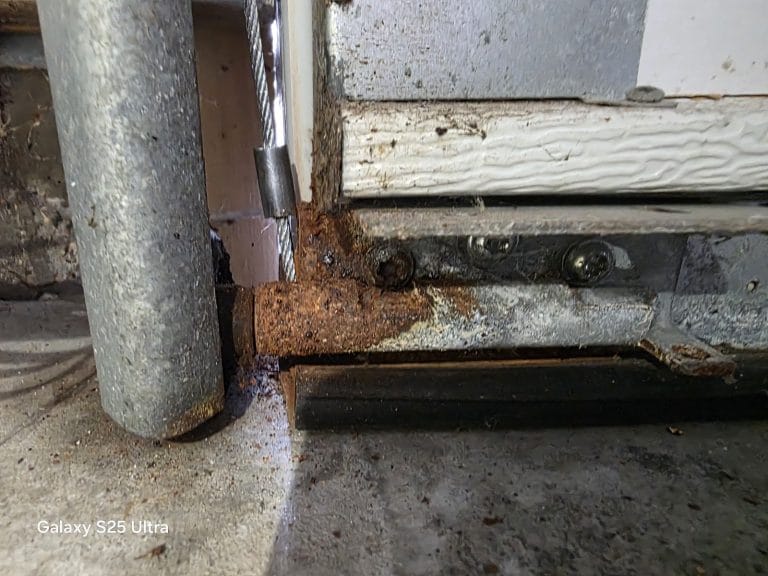
Photos from my own jobs around the Twin Cities.
Problem 1: the extension springs
The two long springs stretched along the horizontal track are the original 1950s technology, and on an 8-foot door that has been replaced with a heavier steel door they are often the wrong size for the door they lift. When one breaks it flies, and the door drops on one side. Most of the ones I see have no safety cable through the spring. A torsion-spring conversion, one spring on a shaft above the door, is the single best thing you can do for a St. Louis Park garage: $150 to $350 for a standard single door, up to $200 more for a double or heavy door; code SPRINGS waives the service call and includes new cables. Spring replacement, explained.
Problem 2: the bottom section on alley and shared-driveway doors
St. Louis Park plows its alleys and the city salts, and a shared driveway drains to the low garage, which is usually yours. The bottom section of the door sits in salty slush from February to April. On a wood door it rots from the bottom rail up; on a 1990s steel door it rusts out at the bottom from the inside. The bottom brackets, where the lift cables anchor and the spring tension lives, rust with it, and a rusted bracket letting go is how a door ends up hanging by one cable. One bad section is a section replacement ($200 to $600, if the panel is still made); a wood door with two soft sections is a new door. A fresh bottom seal and silicone before the first freeze is part of the $129 WINTER tune-up.
Problem 3: the 8-foot door and the SUV
An 8-foot-wide door with a 7-foot-wide SUV leaves six inches a side, and the mirrors and the vertical track meet about once a winter. The off-track repair that follows is from $450 including cables. The permanent fix depends on the garage: a 9-foot door in the same opening is usually possible by moving the jambs and the track a few inches in; a 10-foot door needs the header checked by someone who knows framing; a 16-foot door is a rebuild, and on a 40-foot lot the rebuild runs into the City’s setback rules, which is a conversation with Inspections before it is a conversation with me. How to measure the opening, and off-track repair.
Problem 4: the soft jamb
The vertical track bolts to the wood jamb on each side of the opening. After sixty years of meltwater the bottom foot of that jamb is often soft enough to push a screwdriver into, and the lowest track bolts are holding nothing. The door walks, the rollers bind, and the opener strains. The fix is a short sister piece of pressure-treated lumber behind the jamb and new lag bolts, which I do as part of a track reset; if the whole jamb is gone it is a carpentry job before the door job. This is the thing I check first on every 1950s door in the city, because it decides whether the door is worth any other repair.
What to buy when the door is done
For a St. Louis Park single-stall: a 9×7 insulated steel door if the opening allows it, otherwise 8×7, vinyl-backed at minimum (the DoorLink door I install most, from $2,000 installed with the old door hauled away), galvanized bottom brackets and a bottom section that can sit in meltwater, and a torsion spring sized to the new door. If the garage is attached or heated, a 2-inch steel sandwich door from $2,800. A LiftMaster belt opener, $650 to $1,500 installed; door and opener together with code BUNDLE save $150 through December 31, 2026. DoorLink vs Haas, and how I help people choose. Before any of it, the Age Check tells you what is probably in your garage by the decade your house was built.
St. Louis Park garage door questions
Why do so many St. Louis Park houses have a garage that is too small for a modern car?
Because the house came first and the garage came later, on a 40-foot lot. About 60 percent of St. Louis Park’s homes were built between 1946 and 1954, many to VA specifications on lots the Village allowed at 30 and 40 feet wide. The original single-stall garage, often added in the late 1950s, is 10 or 12 feet wide with an 8-foot door. A 9-foot door in the same opening is usually possible by moving the jambs a few inches; a 16-foot door is a rebuild.
My SLP garage door opens onto the alley or a shared driveway. Does that change the repair?
It changes the wear. Alley doors and shared-driveway doors get plowed snow pushed against them, salt meltwater at the bottom, and the occasional bumper. The bottom section, bottom brackets and the lower vertical track go first. I check those three on every 1950s door in the city before I quote anything.
Should I replace or repair a 1950s wood garage door in St. Louis Park?
If the frame is square and the slab is sound, a wood door with one rotten bottom section and tired extension springs can get a section, a torsion conversion ($150 to $350 for a standard single door) and nylon rollers and run another ten years. If the door is heavy, racked, or the bottom two sections are soft, a new insulated steel door from $2,000 installed costs less than a year of patching, and it weighs half as much, which is what the original hardware wants.
How fast can you get to St. Louis Park?
I am based in St. Louis Park, so usually within the hour, same day, including nights and weekends with no weekend surcharge (night surcharge only after 9 PM). Call or text (763) 265-7671.
What does a garage door tune-up cost in St. Louis Park?
$129 with code WINTER through December 15, 2026, otherwise $155: lubricate and check the springs, hinges and rollers, balance the door, check cables and bottom brackets, set the opener’s force and safety reverse, and silicone the bottom seal so it cannot freeze to the slab.
In the city itself, the garages are on the alley: Minneapolis alley garage doors, single-stall, tandem and rebuilt.
If the door is stuck open, crooked or will not lift and it cannot wait, this is what my emergency garage door repair service is for. Call (763) 265-7671, day or night.