Key facts in 20 seconds
- Most of Edina was built between 1945 and 1974, expanding south and west toward Braemar (opened 1964): ramblers and split-levels with the first attached two-car garages, usually one 16-foot door, under or beside a bedroom.
- The four things I fix on these doors, in order: noise upstairs (chain opener + steel rollers on a shared floor), the original extension springs without safety cables, a bottom section that has soaked up 50 winters of meltwater, and a 16-foot door that sags in the middle.
- Prices from my cost calculator: torsion conversion $150 to $350 (single; up to $200 more for a double), belt opener $650 to $1,500, new insulated steel door from $2,000, 2-inch sandwich door from $2,800; door + opener with code BUNDLE saves $150 through Dec 31, 2026.
- The Age Check tells you what is probably in your garage by decade; call (763) 265-7671 for the exact answer, 10 minutes from St. Louis Park.
Drive south of 70th Street or west of Highway 100 in Edina and you are in the houses that Southdale built. The 1953 deal that created the mall also opened the land around it, and from the late 1950s through the early 1970s Edina added most of the neighborhoods it has today: Lake Cornelia, Pamela Park, Cahill, Brookview Heights, Indian Hills, Parkwood Knolls, the streets around Braemar. The houses are ramblers and split-levels (split-entry, side-split, bi-level, people use all three names), and almost every one of them has something the older Morningside and Country Club houses do not: an attached two-car garage with a single wide door, built into the house, often under a bedroom. This guide is about that door. It pairs with my guides to Edina’s older detached garages and the Country Club carriage houses; the tuck-under guide covers the ones where the garage is fully under the house.
What a 1960s attached garage is
A 20-by-22-foot bay, slab on grade, with one 16-foot-wide, 7-foot-tall door. The wall between the garage and the house is the fire wall; the ceiling is the floor of the family room or the bedrooms on a split-level, or the attic of a rambler. The original door was a wood or hardboard sectional, sometimes a one-piece tilt-up, hung on extension springs along the horizontal track, with a chain-drive opener added in the 1970s or 80s. Half of the doors I see on these houses have been replaced once, usually in the 1990s with a thin non-insulated steel door; the other half are on their original hardware with a new skin.
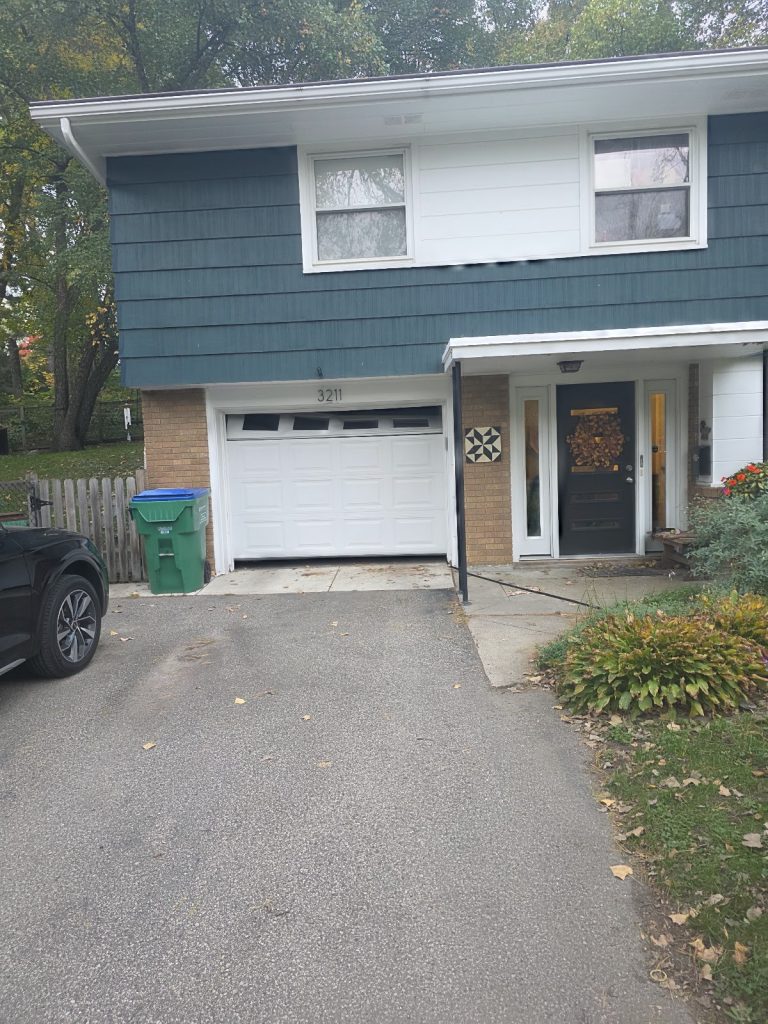
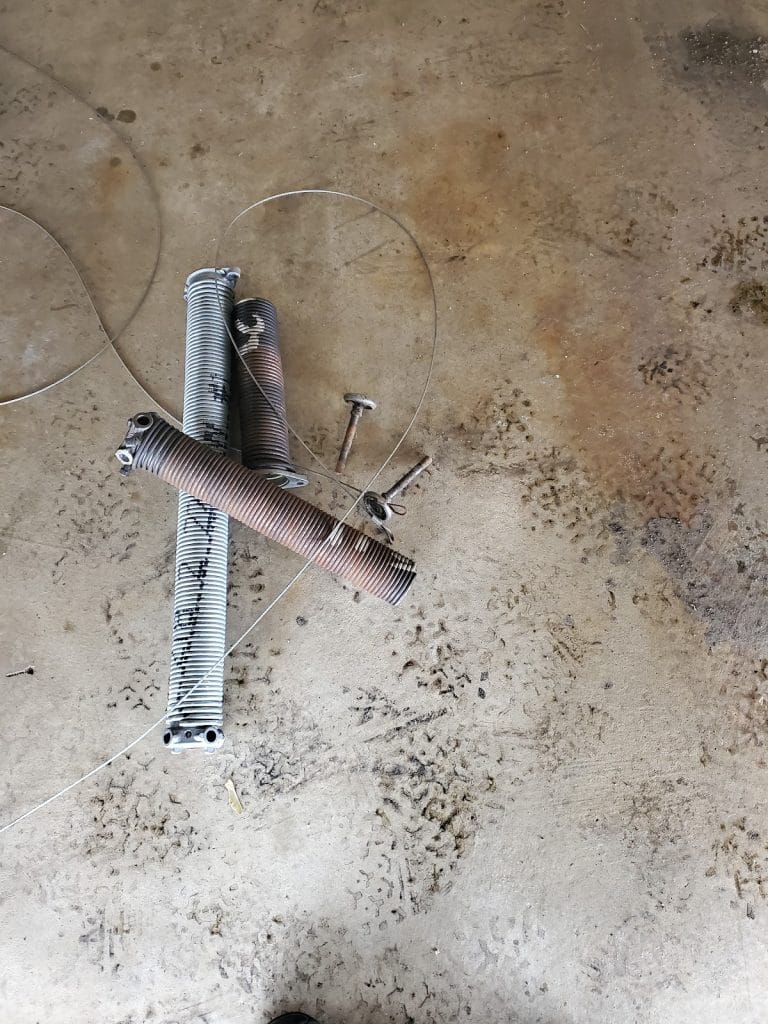
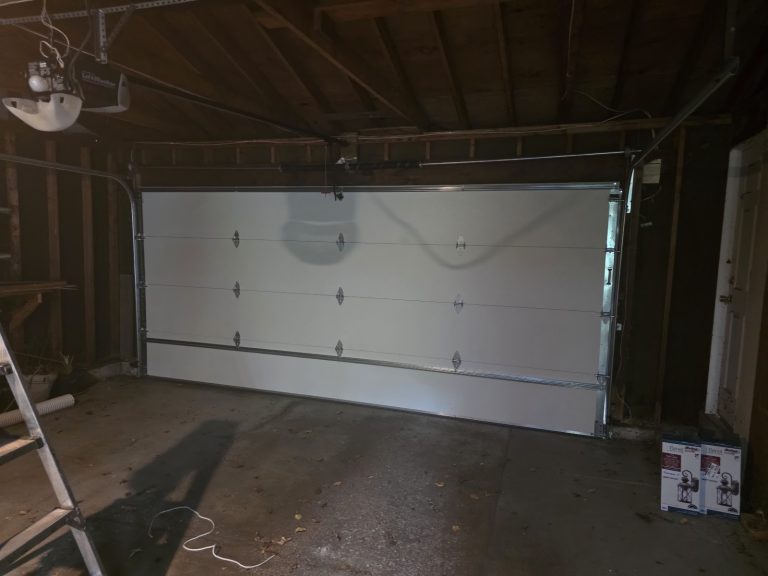
Photos from my own jobs around the Twin Cities.
Problem 1: the noise upstairs
The number one complaint from Edina split-levels is not that the door does not work; it is that every time it works the whole house knows. The garage ceiling joists are the bedroom floor joists. A chain-drive opener bolted to those joists, steel rollers in a steel track and a 16-foot door with loose hinges make a drum out of the house. In order of cost: new nylon rollers and a proper tune-up (tighten every hinge, lubricate, balance the spring) take out most of the rattle; a belt-drive LiftMaster opener with rubber isolation takes out the motor noise; and a wall-mount jackshaft opener, which bolts beside the torsion shaft instead of to the ceiling, takes the motor off the joists entirely. On a bedroom-over-garage house I recommend the belt or the wall-mount every time. Why doors get loud and what quiets them, and the wall-mount opener I install.
Problem 2: the extension springs
If your door has a long spring stretched along each horizontal track, with a pulley at the end, it has extension springs, and if there is no thin cable running through the middle of the spring it has no safety cable. When one of those springs breaks it becomes a projectile, and the door drops on that side and jams. Most 1960s doors were built this way. A torsion-spring conversion, one spring on a shaft above the door, is the single best upgrade on these houses: it balances the door properly, it is safer, and the opener works half as hard. $150 to $350 for a standard single door, up to $200 more for a double or heavy door; code SPRINGS waives the service call and includes new cables. Spring replacement, explained.
Problem 3: the bottom section
An attached garage on a split-level sits a few inches above the driveway, and the driveway drains toward the house as often as away from it. Fifty winters of meltwater and salt wick into the bottom section; on a wood door it rots, on a 1990s steel door it rusts out from the inside at the bottom rail. The tells are a bottom seal that no longer touches the slab evenly, daylight at the corners, and a cold bedroom floor above the garage in January. One bad section on a door that is otherwise sound is a section replacement ($200 to $600, if the panel is still made); two or more, or a door with no insulation at all, is a new door.
Problem 4: the 16-foot sag
A 16-foot door is a long span. The original wood doors sag in the middle after fifty years; thin steel doors from the 90s bow when the opener pulls from the center of a door that has no strut. You see it as a gap in the middle at the top when the door is closed, or a door that drags one side of the track. A reinforcing strut across the top section is the cheap fix on a door worth keeping; on a replacement I use a door with a 2-inch or 3-inch thick section and a factory strut, so the opener pulls a stiff panel. This is also where the two-door conversion comes up; see the questions below.
What to buy when the door is done
For a 1960s attached garage with living space above or beside it: an insulated steel door, 16×7, vinyl-backed at minimum (that is the DoorLink door I install most, from $2,000 installed), or a 2-inch steel sandwich door from $2,800 (Haas is the higher-insulation line) if the garage is heated or there is a bedroom over it. Windows in the top section are worth it on a street-facing door. Pair it with a belt-drive or wall-mount LiftMaster opener, $650 to $1,500 installed, and the two together with code BUNDLE save $150 through December 31, 2026. DoorLink vs Haas, how much insulation an Edina garage needs, and how I help people choose. For the rest of the city, my Edina service page.
A note for Edina Chamber members
David’s Urgent Garage Door joined the Edina Chamber of Commerce in October 2026. Member businesses, their employees and their customers: mention the Chamber and code SPRINGS for the service call waived and new cables included with any spring replacement. Commercial doors on the 50th and France and Southdale shops, and property-manager accounts, are welcome too.
Split-level with the garage under the bedrooms? My tuck-under garage guide covers the headroom, the drain at the bottom of the door and the noise upstairs.
Different decade, different garage? The Garage Door Age Check gives the short list for any garage from the 1920s to today.
Edina split-level garage door questions
Why is my Edina split-level garage door so loud upstairs?
Because the garage ceiling is somebody’s bedroom floor. On a split-level the attached garage sits under or beside the upper level with framing shared between them, so a chain-drive opener and steel rollers on a 1960s track transmit every click through the joists. The fix in order of cost: nylon rollers and a tune-up, then a belt-drive LiftMaster opener, then a wall-mount (jackshaft) opener that takes the motor off the ceiling entirely.
My 1960s Edina house has one 16-foot door. Can I replace it with two doors?
Usually yes, but it is a framing job before it is a door job: a center post and header have to be built, and that is a contractor plus a City of Edina building permit, with the door install after. Most owners keep the single 16×7 and buy a stiffer insulated steel door with a wind-rated strut instead, which fixes the sag and the noise without touching the structure.
How much does a new garage door cost for an Edina split-level?
From the cost calculator: a new insulated steel door is from $2,000 installed with the old door hauled away, a 2-inch steel sandwich door from $2,800, and a LiftMaster myQ opener $650 to $1,500; door and opener together with code BUNDLE saves $150 through Dec 31, 2026. A 16×7 is the common size on these houses. I quote the exact number on site before any work.
What usually fails first on a 1960s attached garage door?
The extension springs, if the door still has them: the original pairs along the horizontal track, often without safety cables, let go without warning and the door drops on one side. Second is the bottom section soaking up driveway meltwater, third the hinges and rollers that have never been lubricated. A torsion-spring conversion ($150 to $350 for a standard single door, up to $200 more for a double) is the single best upgrade on these doors.
Does an attached garage door need to be insulated in Edina?
If there is living space above or beside it, yes, and the door is the biggest hole in that wall. An insulated steel door with a good bottom seal and jamb weatherstrip keeps the garage 10 to 20 degrees warmer than outside, which means a warmer bedroom floor above it, a car that starts, and water pipes on the garage wall that do not freeze. For a heated garage or a workshop, a 2-inch sandwich door.
Cannot wait until tomorrow? I run same-day emergency garage door repair in Minneapolis-St. Paul, usually arriving in about an hour. (763) 265-7671.