
Key facts in 20 seconds
- Every winter the first hard freeze brings a wave of garage door calls across the Twin Cities. Almost all of them were predictable in November.
- Five checks, five minutes, no tools: balance test, photo-eye test, listen and look, lubricate, bottom seal.
- Three things you should never do yourself: adjust or replace a spring, touch the cables or bottom brackets, or keep running an opener against a door that is binding.
- Owner-operated, St. Louis Park, MN contractor #IR790255. Same-day service across the west metro; written price on the driveway before any work. Service area.
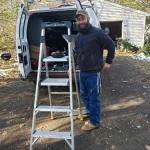
I have fixed garage doors in Minnesota since 2019, and the calendar is the same every year. October is quiet. The first week the thermometer stays below zero overnight, the phone does not stop: springs, cables, openers that “just died”, doors frozen to the floor. Very little of it is bad luck. A spring that breaks in December was already at the end of its life in November; a door that freezes to the slab had a cracked seal in October. This is the check I would do at my own house, in the order I would do it, written so you can do it in five minutes on a Saturday before the cold arrives. If you would rather have me do the check every year, the Family Peace of Mind membership covers it, and the safety checklist is the longer version of these five steps.
Why the first freeze is the breaking point
Three things happen at once. Steel gets less forgiving as it gets colder, so a torsion spring with a hairline crack that would have lasted until March lets go on a cold morning instead. The door itself gets heavier: frost in the panels, snow packed against the bottom, lubricant turned to paste in the hinges. And the opener, which has been quietly compensating for a tired spring all autumn, meets a door it can no longer lift and either strains, strips its gear, or reverses as its safety setting tells it to. The homeowner sees “the opener broke.” The opener is usually the last thing that is wrong.
Video: my quick winter garage door check. More on my YouTube channel.
The five-minute check
- Balance test. Pull the red release cord with the door closed, lift the door by hand to waist height and let go. A balanced door stays put. If it drifts down or shoots up, the springs are wrong or worn, and the opener has been covering for them.
- Photo-eye test. Close the door with the opener and wave a broom through the beam near the floor. The door must reverse. If it does not, or the eyes are blinking, clean the lenses and check that both are pointed at each other.
- Listen and look. Run the door twice. Grinding, popping or a jerk at one spot means a roller, a hinge or a bent track. Look at the cables on each side: any fraying or a loose wrap on the drum is a stop-using-the-door-and-call item.
- Lubricate. Silicone or lithium garage door spray on the springs, hinges and roller stems. Wipe the tracks dry; do not grease them.
- Bottom seal and threshold. Check the rubber along the bottom for cracks, gaps and brittleness. Sweep the slab where the door lands. This is where ice bonds the door to the floor in January.
What each result means
Door fails the balance test. On a door more than seven or eight years old, this is a spring near the end of its roughly ten-thousand-cycle life. Replacing springs as a matched pair, with new cables, before winter is the cheapest version of this repair; replacing one broken spring at 6 a.m. in January with the car behind the door is the most expensive. Do not try to adjust spring tension yourself; a wound torsion spring stores enough energy to break a hand.
Door does not reverse on the photo-eye test. Fix this before anything else. Cleaning the lenses and re-aiming the brackets solves most of it. If the eyes are good and the door still does not reverse, the opener’s logic board or the wiring is the problem, and the door should not be used around children or pets until it is corrected.
Noise or a jerk at one point in travel. Flat-spotted rollers, a cracked hinge or a track that has been bumped by a car. Rollers and hinges are inexpensive and fast to replace; a bent track is a measurement job, not a hammer job.
A frayed cable. Stop using the door. A cable that lets go drops that side of the door and twists the whole thing in the track. This is a same-day call, not a spring project.
A cracked bottom seal. The cheapest fix on this list and the one that prevents the most January calls. A new seal and, where the slab slopes toward the garage, a threshold keep meltwater from freezing the door to the floor.
Minnesota specifics worth knowing
The older the house, the more the check matters. The 1940s and 1950s single-stall garages in St. Louis Park, Richfield and Edina often run extension springs or low-headroom hardware that was never designed for a modern opener. The 1970s and 1980s split-levels in Plymouth, Eagan and Burnsville have uninsulated doors on their third set of springs and an opener bolted under a bedroom. The big lake houses around Lake Minnetonka have the heaviest doors in the metro and get the wind first. Each city page on this site ends with field notes on what that town’s houses do in winter; the index is on the service area page.
One more: if you have a wireless keypad, put a fresh battery in it in November. A tired 9-volt is the number one reason a keypad “stops working” on the first cold morning; I wrote that up separately in garage door keypad not working in the cold.
When to call instead of check
A door that is visibly crooked, a spring with a gap in the coils, a cable off its drum, or a door that will not move at all are not five-minute items. Do not pull the release cord on a door with a broken spring unless you can hold its full weight; it will come down. For those, the right move is a phone call, a photo if you can take one safely, and a written price on the driveway. The check above is for the other ninety percent: the doors that are about to have a problem, and do not have to.
November garage door check – FAQ
How cold does it have to be before a garage door spring breaks?
There is no magic number. A spring breaks when it reaches the end of its cycle life, and cold just moves the date forward: steel is less ductile below about 10 F, and the door is heavier with frost and packed snow. In the Twin Cities the first run of mornings near zero, usually in late November or December, is when the springs that were already close to done let go.
Can I lubricate the springs myself, and with what?
Yes, and it is the single most useful thing a homeowner can do. Use a silicone or lithium garage door spray, not WD-40 (which is a solvent and dries the metal out). A light coat along the torsion springs, the hinges and the roller stems, then run the door a few times. Do not touch the spring tension, the cables, or the bottom brackets; those are under load.
The door reverses on its own when it is cold. Is the opener broken?
Usually not. Cold stiffens the door and the lubricant, the opener meets more resistance than its force setting allows, and it reverses as it is designed to. The first fix is lubrication and a balance test; if the door is heavy on the spring, the opener is doing work it was never meant to do and the spring, not the opener, is the problem.
What does a November tune-up cost compared with an emergency call?
A scheduled service visit is far less than a same-day call on a frozen morning with a car stuck inside, and it almost always finds the thing that would have broken: a frayed cable, a cracked roller, a spring at the end of its life. I quote in writing on the driveway before any work, and if the door is fine I will tell you that too.
If you are reading this after the freeze and the door is already stuck, start with why a garage door won’t open in the cold.
Door stuck right now? I answer the phone 24 hours a day and am usually on site in about an hour: see 24/7 emergency garage door repair or call (763) 265-7671.
For the whole year, not just November, see the complete Minnesota garage door maintenance and repair guide.