
Key facts in 20 seconds
- A standard torsion spring is rated for about 10,000 cycles (one cycle = open + close). At 4 cycles a day that is roughly 7 years; at 8 a day, about 3.5 years. High-cycle springs (25,000-50,000) cost more but last 2-5 times longer.
- Springs do not “wear out” visibly. They fail from metal fatigue: a crack starts on the inside of a coil and one day the spring snaps with a bang. Rust from road salt and lack of lube speed that up.
- On a two-spring door, replace both. They were installed the same day and have the same cycle count. The second one usually goes within months, and you pay a second service call plus a second trip.
- A spring with less than ~20% of its life left shows itself: the door is heavy at the bottom, the opener strains, the door drops when released, the gaps between coils are uneven, or there is a bright orange dust line of rust.
- Never try to “add a few turns” to a tired spring. It does not restore the steel; it just loads a cracked coil harder.
- In the Twin Cities I quote spring replacement with new cables included, because a snapped, rusted cable is what puts the door off track the next winter. Repairs carry a 1-year labor warranty.
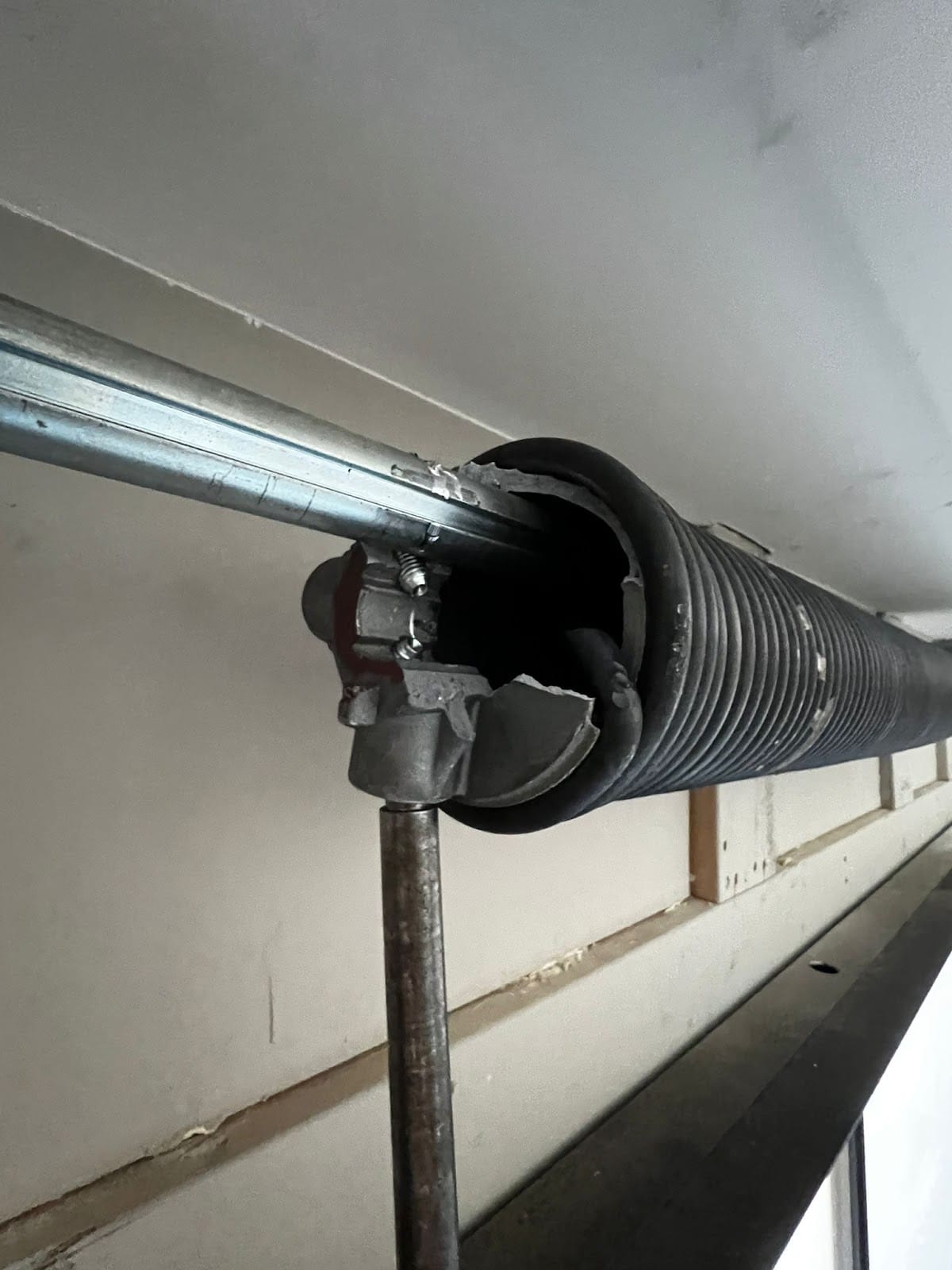
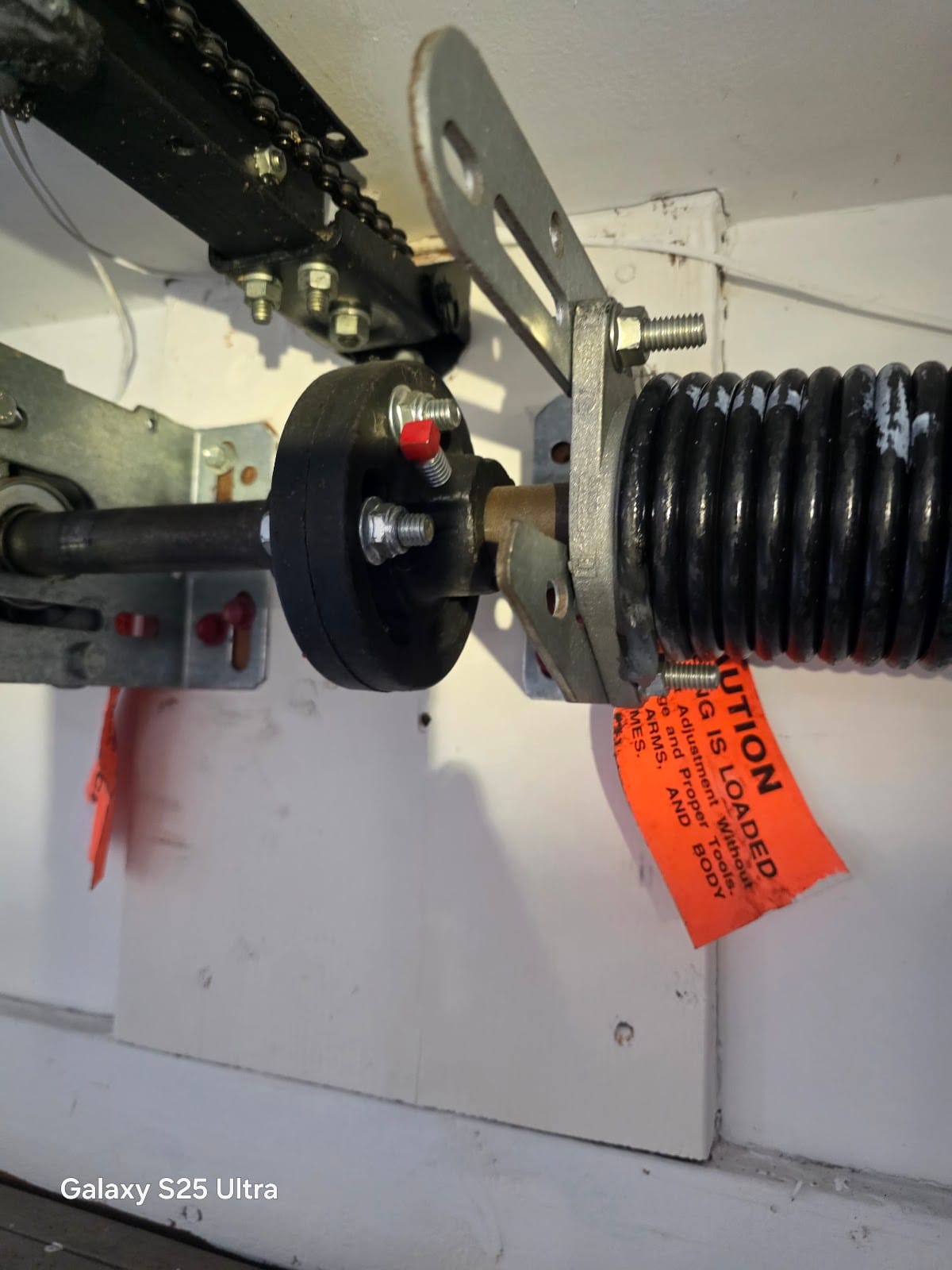
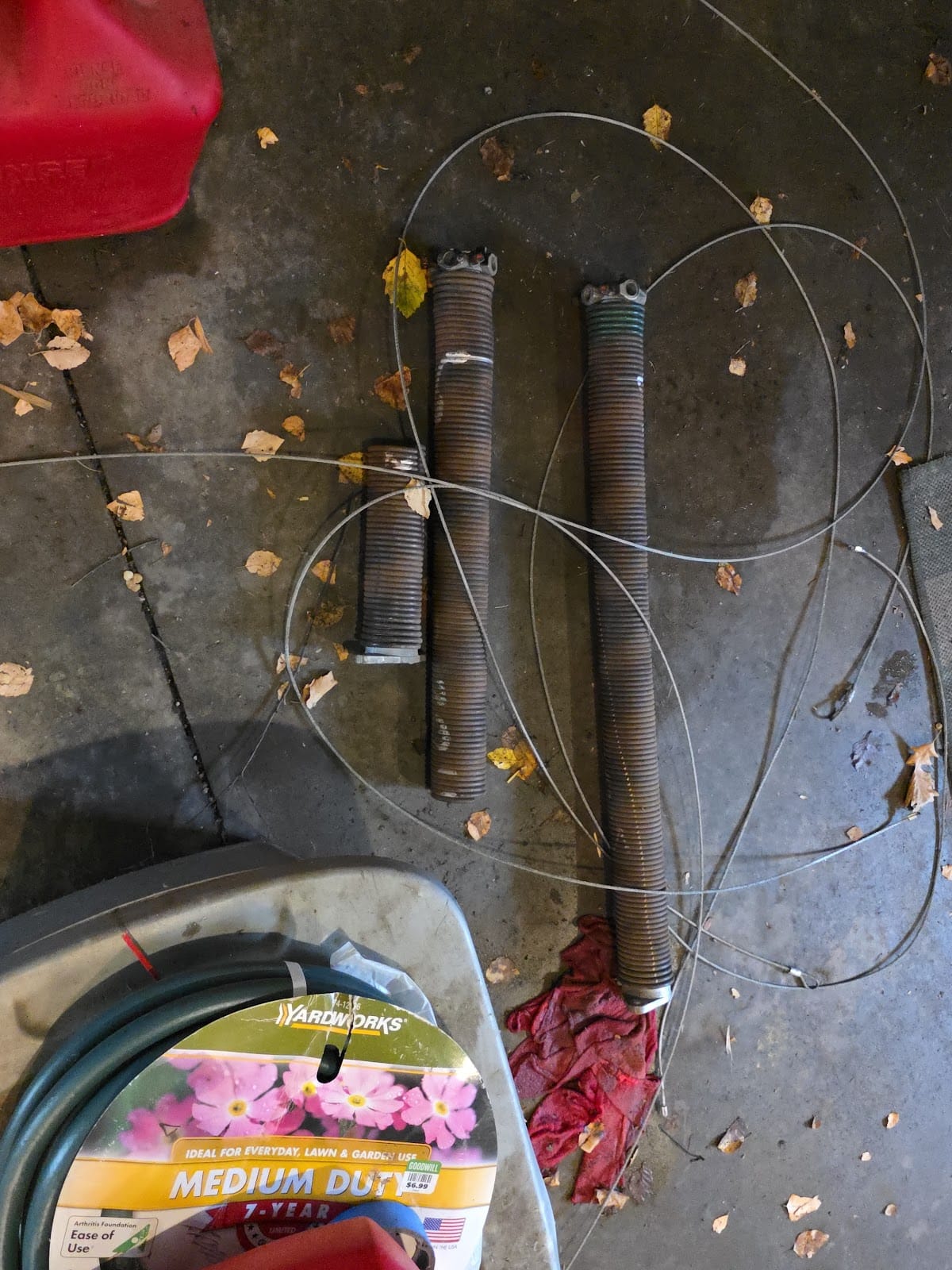
Every spring I take down in Minneapolis, St. Paul and the west metro tells the same story: it was installed with a certain number of lifts in it, nobody counted, and one morning it ran out. This guide answers the questions I get asked at the garage: how long a spring lasts, how to tell how much life is left, whether to replace one spring or both, and whether high-cycle springs are worth it. No sales pitch; the numbers are the ones the spring manufacturers publish and the ones I see on real doors here.
What a “cycle” is and why 10,000 is the standard
One cycle is one full open and one full close. A standard residential torsion spring is designed for a minimum of 10,000 cycles at its rated torque. That number comes from the wire size, the inside diameter and the spring length chosen for the door’s weight. A longer spring of the same wire and diameter makes the same torque with less stress on each coil, so it lasts longer: that is the whole trick behind “high-cycle” springs. The math for sizing is in my torsion spring sizing and IPPT guide; this article is about what that means in years.
How many years is 10,000 cycles?
| Door uses per day (open + close) | 10,000-cycle spring | 25,000-cycle spring | 50,000-cycle spring |
|---|---|---|---|
| 2 (one car, out and back) | ~13.7 years | ~34 years | ~68 years |
| 4 (typical family) | ~6.8 years | ~17 years | ~34 years |
| 6 (two cars + kids) | ~4.6 years | ~11 years | ~23 years |
| 8 (busy household, home business) | ~3.4 years | ~8.5 years | ~17 years |
| 12 (daycare, contractor, main entrance) | ~2.3 years | ~5.7 years | ~11 years |
Count honestly. A family where the garage is the front door, with two cars, kids on bikes and a dog, is easily at 8-10 cycles a day. That is why “the springs are only five years old” is not a surprise to me; at that use they are past their rating. If your door is the main entrance, a 25,000-cycle set is the cheapest upgrade in garage doors, usually a modest add-on to the job price and roughly triple the life.
Can you tell how many cycles are left?
Not with a counter, but the spring tells you in other ways. Fatigue life is used up from the inside of the coil; nothing shows until the last stretch. What you can read is the balance of the door and the condition of the steel.
| What you see | What it means | Life left |
|---|---|---|
| Door stays at waist height when released, lifts with one hand | Springs balanced | Not a cycle count, but the spring is doing its job |
| Door drifts down slowly from waist height; opener sounds louder on the way up | Spring has lost tension (steel relaxed) or was under-wound | Months to a year; schedule a tune-up |
| Door falls when released; opener reverses or stops partway up | Springs far below required torque | Replace now – the opener is lifting dead weight |
| Uneven coil spacing, a “bump” or kink in the coil | Micro-crack opening up | Weeks |
| Rust dust on the spring or on the floor under it, pitting on the coils | Corrosion from road salt and humidity eating into the surface | Cycle life cut by a third or more |
| A 2-inch gap in the spring, loud bang heard, door will not open | Fatigue fracture – the spring is done | 0 |
The balance test is simple and safe: with the door fully closed, pull the red release cord, lift the door by hand to about waist height and let go gently. A door with healthy springs stays there. Anything else is a spring problem, and it is also why the opener force settings should never be raised to compensate.
Replace one spring or both?
| Situation | Replace one or both? | Why |
|---|---|---|
| Two-spring door, one broken, both the same age | Both | Equal cycles; the survivor is at the same point in its fatigue life. Mixing an old and a new spring also unbalances the door and loads the new one unevenly |
| Two-spring door, one was replaced less than a year ago | One is acceptable if it is the same size (wire, inside diameter, length) | Cycle counts differ enough; match the spec exactly, not “close” |
| Single-spring door (common on 8- and 9-foot doors) | Replace it; consider upgrading to two springs | Two smaller springs share the load, and if one breaks the other keeps the door from slamming |
| Extension springs (one each side, along the horizontal track) | Both, with safety cables, or convert to torsion | They stretch unevenly, and a broken extension spring without a safety cable becomes a projectile |
The economics are plain. The spring itself is a small part of the bill; the service call, the trip and the labor are the rest. Replacing both springs on one visit adds a little for the second part and nothing for the second trip. Replacing one now and the other in four months means two trips, two labor charges and a door that is unbalanced in between. That is why nearly every reputable company in the Twin Cities quotes two springs on a two-spring door.
Minnesota: why our springs die younger
- Road salt. Salt spray comes in on the car, drips off, and the humid air in the garage carries it to the spring, cables and bottom brackets. Pitting on the coil surface is where fatigue cracks start. I see rust on cables and bottom brackets on almost every repair.
- Cold. Spring steel is stiffer and more brittle at -20°F. A high share of the spring calls I get are the first bitter cold mornings of January.
- Dry, un-lubricated coils. A spring that is never oiled rubs coil on coil. A light coat of garage-door lubricant (not WD-40) across the spring twice a year, ideally during the fall tune-up, measurably extends its life.
- Ice on the door. A door with an inch of ice on the bottom panel weighs more than the springs were sized for, which is extra stress on every cycle.
What a proper spring replacement includes
- Weigh the door (not guess from the old spring; old springs are often wrong) and size the new pair for that weight: see how much a garage door weighs.
- Replace both springs on a two-spring door, with the correct wind (left and right) on each side.
- Replace the lift cables and inspect the bottom brackets, drums and center bearing. In this climate I include new cables on every spring job, because a rusted cable snapping is the most common cause of an off-track door the following winter.
- Wind to the door’s weight, set the cable tension evenly, balance-test at three heights.
- Re-set the opener’s travel limits, re-learn the force, run the 2×4 reversal test and the sensor test.
- Lubricate springs, hinges and rollers.
Pricing and the current spring offer (service call waived, cables included) are on the spring repair page and special offers.
Should you replace a spring before it breaks?
If the door fails the balance test, if the springs are visibly rusted or kinked, or if they are past roughly 7 years on a normally used door, yes, and plan it rather than wait. A spring that breaks while the door is open can let the door fall; one that breaks with the car inside means a morning you cannot get to work. Replacing on your schedule, with the door closed, during a scheduled visit, costs the same as the emergency version and none of the stress. If you would rather have someone else keep track, that is exactly what the annual maintenance plan is for.
Garage door spring life – FAQ
How long do garage door springs last?
A standard torsion spring is rated for about 10,000 cycles. At a typical four opens and closes a day that is roughly seven years; at eight a day about three and a half. High-cycle 25,000- and 50,000-cycle springs last two to five times longer. Road salt rust and no lubrication shorten the life in Minnesota.
Should I replace both garage door springs if only one is broken?
Yes on a two-spring door of the same age. Both springs have the same cycle count, the second usually fails within months, and a new spring paired with a tired one unbalances the door. Replacing both on one visit avoids a second service call.
How do I know if my garage door springs are going bad?
Do the balance test: release the opener, lift the door to waist height and let go. If it drops or drifts, the springs are weak. Other signs are a door that is heavy at the bottom, an opener that strains or reverses, uneven coil gaps, rust dust and a visible gap in the coil once it has snapped.
Are high-cycle garage door springs worth it?
For a door used as the main entrance, yes. A 25,000-cycle set is a modest add-on to the job cost and lasts about 2.5 times longer than a standard set, which usually means skipping an entire future spring replacement.
Can a garage door spring be re-tensioned instead of replaced?
Adding winds to a spring that has lost tension through fatigue only loads the cracked steel harder. A spring that was under-wound at installation can be corrected, but a spring that has relaxed with age or shows rust or kinks should be replaced.
Owner-operated from St. Louis Park, about one hour away for most calls in Edina, St. Louis Park, Plymouth, Minnetonka, Golden Valley, Hopkins, Bloomington and the rest of the west metro. Call or text (763) 265-7671.